Pharmacovigilance Jobs for Freshers in India: A Complete Career Guide

Pharmacovigilance jobs for freshers in India are entry-level roles where you monitor, assess, and report adverse drug reactions to ensure medicines are safe for patients. These roles demand knowledge of global regulations and case processing. Starting salaries range from ₹2.5 to 4.5 LPA, with rapid growth potential.
You just graduated. BDS, BHMS, BAMS, Nursing—your degree is hard-earned. But now you’re feeling lost. The industry looks closed. Here’s the brutal truth: clinical knowledge alone won’t get you hired. However, your background is exactly what the pharma industry needs in pharmacovigilance jobs for freshers in India. Companies are desperate for freshers who understand medicine—they just need you to speak the PV language.
You’re not lacking potential; you’re lacking a bridge. This guide will cut through the noise and show you exactly how to land a Drug Safety Associate role in the next 3–6 months.
Build These Skills Now
Programs from ZANE ProEd Academy that directly address the skill gaps discussed above.
What is pharmacovigilance and why is it important?
Pharmacovigilance (PV) is the science of detecting, assessing, and preventing adverse effects of medicines. It’s a vital public health function. When a new drug enters the market, real-world patients may experience unexpected reactions. PV professionals collect these reports, analyze them, and share findings with regulators like CDSCO and WHO. This helps update safety labels, restrict use, or even recall dangerous drugs. Without PV, millions could be harmed. For freshers, this is not just a job—it’s a mission-critical career that directly saves lives.
What is the salary of a Drug Safety Associate in India?
Your first question is always about money. Here’s the real picture: Pharmacovigilance salary in India for freshers starts at ₹2.5–₹4.5 lakhs per annum (LPA). This varies by city, company, and your training. With just 1–2 years of experience, you can jump to ₹5–7 LPA. Senior roles like PV Scientist or Team Lead pay ₹8–15 LPA. Remember, these numbers reflect a non-IT domain, so they’re decent for a start. The key is to enter with a solid skill set, not just a degree.
How to start a career in pharmacovigilance?
Start by understanding the PV career path: most freshers join as Drug Safety Associates (DSA) or PV Associates. From there, you move to case processing, aggregate reporting, or signal detection. To begin, you need three things:
- Knowledge of global regulations: ICH guidelines (ICH), GVP modules from EMA.
- Practical skills: case intake, triage, MedDRA coding, narrative writing.
- Certification or training that proves you can handle real-world cases.
Formal degrees don’t cover these. You must bridge the gap yourself. More on that below.
What are the job responsibilities of a PV Associate?
A drug safety associate job description typically includes:
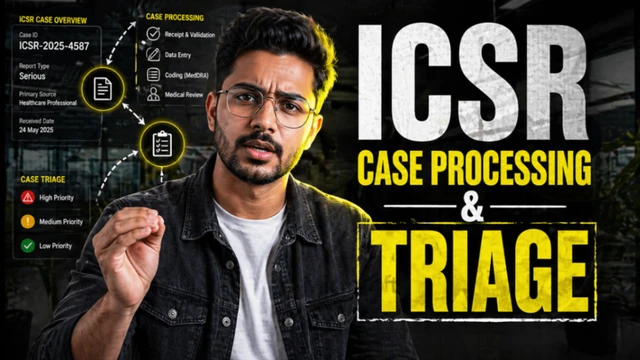
- Case Receipt and Triage: You receive adverse event reports from patients, doctors, or clinical trials. You assess seriousness and priority.
- Data Entry and Coding: You enter data into safety databases like Argus or ArisG, and code medical terms using MedDRA.
- Narrative Writing: You write a clear medical story of the adverse event, following ICH guidelines.
- Follow-up: You contact reporters for missing information to complete cases.
- Quality Check: You ensure data accuracy and compliance with regulations.
These are the drug safety associate roles and responsibilities you’ll handle daily. Employers expect you to start case processing with minimal hand-holding. Simulation-based training prepares you for exactly this. Read more about case processing in our detailed guide.
Is pharmacovigilance a good career for BPharm freshers?
Absolutely. But it’s not just for BPharm. Pharmacovigilance careers welcome BDS, BHMS, BAMS, Nursing, and all life science graduates. Your clinical knowledge gives you an edge—you can understand adverse events better than non-medical graduates. The demand is high, and the work is stable. It’s a desk job, but it’s meaningful. And with the right pharmacovigilance course for BPharm or any allied health grad, you can enter quickly.
The Skill Gap: What College Never Taught You
Your degree taught you anatomy, pharmacology, maybe even pharmacovigilance definitions. But employers don’t test your theory. They test your ability to process a case in 20 minutes using a safety database. They expect you to know ICH E2B guidelines, MedDRA coding, and narrative writing on day one. This is the brutal reality. Colleges focus on concepts; the PV industry demands execution. Without bridging this gap, your applications will keep getting rejected.
Your 5-Step Roadmap to a PV Job in 3–6 Months
- Learn the Global Standards: Study ICH guidelines and GVP modules. Focus on E2B data elements and case processing workflows.
- Get Hands-On Training: Enroll in a simulation-based program that mimics real PV databases. Practice case triage, coding, and narrative writing.
- Master Tools & Terminology: Become comfortable with MedDRA, WHO Drug Dictionary, and safety databases like ICH-compliant systems.
- Build a Portfolio: Document 10–15 complete cases you have processed. Show your narrative writing skills.
- Apply Strategically: Target CROs and pharma companies hiring freshers through campus drives or walk-ins. Use your new skills to ace the interview tests.
Simulation: The Bridge from Theory to Job-Ready
Reading won’t make you job-ready. You need to make mistakes in a safe environment. Simulation-based learning puts you in front of a mock safety database, just like the one used at top pharma companies. You receive dummy adverse event reports, triage them, code with MedDRA, write narratives, and submit for quality review. This repeated practice builds the speed and accuracy that employers demand. When you walk into an interview, you’re not a fresher—you’re a trained case processor.
Build These Skills Now
Programs from ZANE ProEd Academy that directly address the skill gaps discussed above.
These programs break down complex PV workflows into manageable modules. You start with ICSR case processing and triage, learning to identify valid cases, determine seriousness, and assign priorities. Then you advance to end-to-end pharmacovigilance certification, covering aggregate reporting, signal detection, and regulatory submissions. Each module is built on real regulatory frameworks, ensuring you’re industry-aligned from day one.
This isn’t about buying a course—it’s about adopting a system that transforms your clinical knowledge into employable PV skills. With guided simulations and expert feedback, you’ll be ready to clear any entry-level interview test.
Check Your Job Readiness
Ask yourself: Can I code an adverse event with MedDRA in under two minutes? Can I write a concise narrative following ICH E2B? If not, you’re not ready. But you can be. Set a 3-month target, follow the roadmap, and practice relentlessly. Your first pharmacovigilance job is closer than you think.
Build These Skills Now
Programs from ZANE ProEd Academy that directly address the skill gaps discussed above.