Pharmacovigilance Case Processing Jobs Freshers: Recruiter’s Complete Guide

Pharmacovigilance Case Processor is an entry-level role where freshers review and enter safety reports on drug side effects. For BSc/MSc Chemistry graduates, pharmacovigilance case processing jobs freshers require ICSR processing, MedDRA coding, and basic medical knowledge. Most companies hire freshers with these skills and pay ₹2.5–4 LPA.
If you have a BSc or MSc in Chemistry and keep getting rejection emails for pharmacovigilance case processing jobs freshers, you are not alone.
Recruiters see hundreds of resumes every week. Most of them lack one thing: proof that you can actually process a safety case.
Build These Skills Now
Programs from ZANE ProEd Academy that directly address the skill gaps discussed above.
I have hired PV case processors for top CROs. Let me show you exactly why you are getting rejected and how to fix it in the next six months.
What does a Pharmacovigilance Case Processor do in pharmacovigilance case processing jobs freshers?
A Pharmacovigilance (PV) Case Processor handles individual case safety reports (ICSRs). You receive reports of side effects from patients, doctors, or clinical trials. Your job is to enter this data into safety databases.
Here is what a typical day looks like:
- Receive an adverse event report by email, phone, or database.
- Check if the report is valid and complete.
- Enter data into safety systems like Argus or ArisG.
- Code medical terms using MedDRA.
- Assess seriousness and causality.
- Submit reports to regulators within deadlines.
This role is the entry point for a career in drug safety. It is perfect for BSc and MSc Chemistry graduates because you already understand chemical structures and biological effects.
What is the salary of a PV Case Processor in India?
The PV case processor salary India ranges from ₹2.5 LPA to ₹4 LPA for freshers in CROs and pharma companies. With 2–3 years of experience, it grows to ₹5–7 LPA.
- Fresher (0–1 year): ₹2.5–4 LPA
- Associate (2–3 years): ₹4–6 LPA
- Senior Case Processor (4–6 years): ₹6–9 LPA
Location matters. Metro cities like Hyderabad, Bengaluru, and Pune pay higher. Night shift roles often add 10–20% extra allowance.
How to get a PV case processing job as a fresher?
You need three things: basic PV knowledge, software familiarity, and a CV that speaks recruiter language.
- Learn ICSR processing workflow from start to finish.
- Practice MedDRA coding on real case examples.
- Take a simulation-based course that gives hands-on experience.
- Build a project portfolio with sample ICSRs you processed.
- Apply to CROs like Accenture, Cognizant, IQVIA, and Wipro.
Do not just list “pharmacovigilance training” on your CV. Show output. Recruiters look for keywords like “triage,” “seriousness assessment,” and “MedDRA version 26.1.”
What is ICSR processing in pharmacovigilance?
ICSR stands for Individual Case Safety Report. It is a report of one patient experiencing a side effect after taking a medicine. ICSR processing career is a stable entry into PV.
The basic steps are:
- Triage: Check if the report is valid (patient, reporter, drug, event).
- Data entry: Enter all details into the safety database.
- Duplicate check: Search for existing cases to avoid double counting.
- Coding: Use MedDRA for medical terms.
- Assessment: Decide seriousness, expectedness, and causality.
- Submission: Send to health authorities like CDSCO or FDA within deadlines.
Regulators like ICH, WHO, FDA, CDSCO, and EMA set the global rules for ICSR processing.
What is MedDRA coding and how is it used in PV?
MedDRA is the Medical Dictionary for Regulatory Activities. It is a standard vocabulary for side effects and medical conditions. MedDRA coding for freshers is a must-have skill.
You map the reported event like “patient felt very dizzy” to a standard term like “Dizziness.” This ensures all companies and regulators speak the same language.
- MedDRA has 5 levels: System Organ Class (SOC), High Level Group Term (HLGT), High Level Term (HLT), Preferred Term (PT), and Lowest Level Term (LLT).
- Case processors usually code at PT level.
- You must know how to search terms and select the correct code using browsers like MedDRA MSSO.
This skill is tested in almost every PV case processor interview. You can practice with free browser trials and case examples.
What do BSc/MSc Chemistry graduates lack when applying for adverse event reporting jobs?
Colleges teach you organic chemistry, spectroscopy, and lab work. But they rarely teach you pharmacovigilance. That is why recruiters reject you.
Here is the gap:
- College teaches: Drug synthesis, chemical reactions, lab reports.
- Employer expects: ICSR processing, MedDRA coding, safety database navigation, regulatory timelines.
You are not deficient. You just have an academic skill set that is not aligned with adverse event reporting jobs. The fix is practical training, not more theory.
What is the fastest way to get your first PV job in 6 months for a non-medical background?
Follow this exact roadmap. I have seen Chemistry graduates land PV jobs in 4–6 months using this path.
- Month 0–1: Learn PV fundamentals. Read ICH E2E guidelines and basic ICSR workflow.
- Month 1–2: Complete a hands-on simulation course in ICSR case processing and MedDRA coding. Do not just watch videos—process sample cases.
- Month 2–3: Build a portfolio with 5–10 sample ICSRs you entered and coded. Document your triage decisions.
- Month 3–4: Update your CV with action verbs and PV keywords. Apply to 20–30 CRO jobs weekly.
- Month 4–6: Attend interviews. Talk about your simulation case work. Show your portfolio link.
This is the same advice I give to candidates who get hired.
Why do freshers fail PV case processing interviews without practical training?
Most interviews ask scenario questions: “A patient reports a rash after taking Drug X. What do you do first?” If you only know theory, you freeze.
Employers do not want to train you from zero. They expect you to understand the workflow on day one. Simulation-based learning is the bridge between your Chemistry degree and a PV job.
You practice on real case scenarios, enter data into mock safety databases, and code events using MedDRA. This builds the exact skill employers pay for.
Build These Skills Now
Programs from ZANE ProEd Academy that directly address the skill gaps discussed above.
How can you get hands-on ICSR and MedDRA training without a job?
Systems like ZANE ProEd give you a lab environment, not just videos. You work through case scenarios exactly like a PV case processor in a CRO.
Two specific programs fill the biggest gaps:
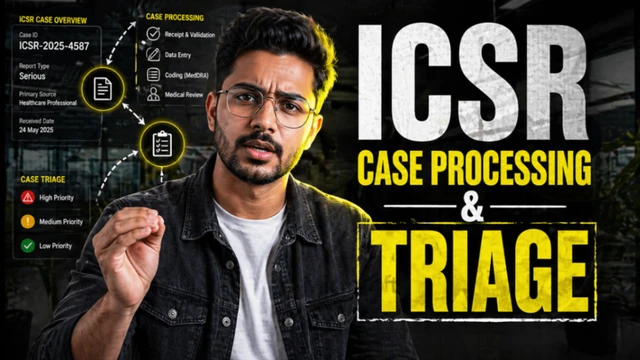
- ICSR Case Processing & Triage: Learn to receive, validate, and enter safety reports. Understand duplicate checks and seriousness assessment.
- MedDRA Medical Coding Certification: Practice coding adverse events using the official MedDRA browser. Learn from real case examples.
These are not generic courses. They simulate the daily tasks of a PV case processor. You build a portfolio that proves you can do the job. This is what recruiters want to see.
Need more detail on the full career path? Read our pharmacovigilance case processing jobs freshers guide and our free pharmacovigilance course certificate article.
Check your job readiness now. Compare your current skills against the exact checklist recruiters use. See where you stand before applying again.
Build These Skills Now
Programs from ZANE ProEd Academy that directly address the skill gaps discussed above.