MedDRA Coding Examples: Verbatim to SOC Step by Step

MedDRA coding examples show how a reporter's wording, such as 'tummy upset', is matched to a Lowest Level Term (LLT) and then rolled up through PT, HLT, HLGT and SOC. In E2B(R3) reports the LLT is the code captured for each reaction, so choosing it accurately matters most.
Searchers looking for meddra coding examples usually have a real case narrative in front of them and need to see how each word becomes a code. This guide works through the hierarchy, a verbatim-to-SOC walkthrough, common errors, and what certification means in practice.
How does the MedDRA hierarchy work (LLT to SOC)?
MedDRA (the Medical Dictionary for Regulatory Activities) groups medical concepts into five levels. The Lowest Level Term (LLT) is the most specific wording, and each LLT links to one Preferred Term (PT). PTs roll up to High Level Terms (HLT), then High Level Group Terms (HLGT), and finally to System Organ Classes (SOC).
Build These Skills Now
Programs from ZANE ProEd Academy that directly address the skill gaps discussed above.
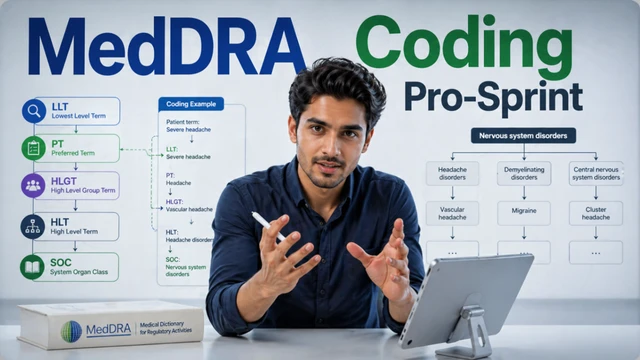
The ICH E2B(R3) standard requires the MedDRA LLT for the reaction, captured in element E.i.2.1b [1]. Periodic safety reports often summarise adverse reactions by SOC and PT, which shows why both levels matter downstream [3].
| Level | What it represents | Role in pharmacovigilance |
|---|---|---|
| LLT | Most specific term, close to the reporter's wording | Captured in the ICSR reaction field (E.i.2.1b) [1] |
| PT | Standard term for one medical concept | Basic unit for counts, listings and signal detection |
| HLT | Groups related PTs by anatomy, pathology, or purpose | Used for broader grouping in aggregate analysis |
| HLGT | Groups related HLTs | Used for higher-level summaries |
| SOC | Broadest class, such as Gastrointestinal disorders | Used in periodic report tables and summaries [3] |
A PT can sit under more than one HLT, while each PT has one primary SOC. Always read the exact term titles and hierarchy in the MedDRA browser for the version you are using, because titles change between versions.
Only one MedDRA version may be used in a single ICSR [1]. Mixing versions within one case file is a data integrity error that should be caught at QC.
How do you code a verbatim term in MedDRA?
A verbatim is the reporter's own wording, which is kept for reference while the coder selects the matching term. The original words are carried in the reaction text field, with an English translation where needed for international transmission [1].
- Read the full verbatim and the narrative, and identify every reaction, sign and symptom.
- Check whether a diagnosis was reported. If a diagnosis with characteristic signs is given, the preferred option is to code the diagnosis only [2].
- Search the MedDRA browser using the key clinical concept, then try synonyms and lay terms.
- Select the LLT that most closely matches the reported wording, not a broader term for convenience.
- Confirm the PT, HLT, HLGT and SOC for that LLT and check they make clinical sense.
- If no suitable term exists, use the best MedDRA approximation guided by MedDRA Term Selection: Points to Consider [1].
- Record the code and the MedDRA version, then document any judgment in the case comments.
Worked example: three verbatims
The terms below are teaching examples. Confirm each LLT, PT and SOC in the browser for the version your case uses.
| Verbatim | Selected LLT | PT | SOC | Coding note |
|---|---|---|---|---|
| tummy upset | Abdominal discomfort | Abdominal discomfort | Gastrointestinal disorders | Lay term mapped to clinical wording |
| sugar went very high | Blood glucose increased | Blood glucose increased | Investigations | Lab-type finding, so check whether a test result is also reported |
| fell over, hit my head, now seeing double | Fall; Diplopia | Fall; Diplopia | Injury, poisoning and procedural complications; Eye disorders | Three events, so code each one separately |
For the first row, the coder reads 'tummy upset' as a stomach-related discomfort, searches the browser, and selects the LLT that matches the reporter's meaning. The SOC then follows automatically from the hierarchy. The coder does not pick the SOC directly.
What are common MedDRA coding mistakes?
Most errors come from coding the wrong concept rather than from the browser itself. The points below are the ones QC reviewers most often flag.
- Coding the indication as a reaction. The indication should not appear in the reactions section unless the medical condition worsened [2].
- Coding a diagnosis and every symptom without thought. Where a diagnosis is reported, the preferred option is the diagnosis, and symptoms are coded only where they are not part of it [2].
- Coding to a broader term to avoid searching. Choosing a generic PT where a specific LLT exists loses information that signal detection needs.
- Mixing MedDRA versions in one ICSR. Only one version is allowed per report [1].
- Requiring identical codes on rechallenge. On re-administration, codes need not be identical; medical judgement decides whether events are conceptually similar [4].
- Forgetting product quality issues. For a suspected quality defect, the LLT closest to the product issue should be added alongside the reaction, with details in free text [2].
How do you become a certified MedDRA coder?
There is no single licence that makes someone a certified MedDRA coder. MedDRA itself is licensed to subscribers, and the MSSO maintains the current terminology and guidance [1]. Training providers offer courses that use the term 'certification', so a candidate should check what is assessed before paying.
Employers in pharmacovigilance usually test practical skill: browser searching, LLT selection, E2B(R3) field entry, and the ability to explain a coding choice. A certificate helps most when it is backed by work a hiring team can see. Readers from clinical coding backgrounds can compare the coding logic in Medical Coding Jobs for Freshers in India: The Complete Decision Framework for IT/BPO Switchers, and common entry-level errors are covered in Medical Coding Jobs for Freshers in India: 7 Mistakes BPharm Graduates Must Fix.
Key takeaways
- The MedDRA hierarchy runs LLT, PT, HLT, HLGT and SOC, and the LLT is the code captured for each reaction in E2B(R3) [1].
- Code the closest LLT to the reporter's wording, then check the PT and SOC in the browser for the version used.
- Code a diagnosis when one is reported, and code symptoms only where they are not part of it [2].
- Use one MedDRA version per ICSR, and do not require identical codes on rechallenge where events are conceptually similar [1][4].
- Treat 'certified MedDRA coder' as a claim to verify through practical skill, not as a title.
Build These Skills Now
Programs from ZANE ProEd Academy that directly address the skill gaps discussed above.
How can you practise MedDRA coding hands-on?
Structured practice on LLT selection, hierarchy navigation and E2B(R3) coding fields is the fastest way to build the skill employers test. The ZANE ProEd MedDRA Medical Coding Certification course is an intermediate, 4-5 day programme that works through LLT-to-SOC logic, complex multi-event cases and version transitions.
Frequently asked questions
Can one verbatim map to more than one MedDRA term?
Yes. When a verbatim describes several reactions, each one is coded separately. Where no diagnosis is given, the reported signs and symptoms are listed and coded individually [2].
Do organisations need to be MedDRA subscribers?
Organisations that use MedDRA are subscribers, and subscribers can submit proposed changes to the terminology through the MSSO, which reviews them [1].
Is a MedDRA coder the same as a drug safety associate?
Not exactly. A coder focuses on term selection, while a drug safety associate or case processor handles the full case, including intake, seriousness, causality and reporting. Many roles combine both tasks.
Should I code the sender's diagnosis or the reporter's words?
Code the reaction terms from the reporter's description, and use the sender's diagnosis field when the sender wants to combine signs into a diagnosis or disagree with the reporter [2].
Sources
- ICH E2B(R3): Electronic Transmission of Individual Case Safety Reports (ICSRs): Data Elements and Message Specification (R3). ICH.
- EMA Good Pharmacovigilance Practices (GVP) Module VI: Collection, management and submission of reports of suspected adverse reactions (Rev 2). EMA.
- ICH E2C(R2): Periodic Benefit-Risk Evaluation Report (PBRER) (R2). ICH.
- ICH E2B(R3) Questions and Answers (Q&A (2025)). ICH.
Build These Skills Now
Programs from ZANE ProEd Academy that directly address the skill gaps discussed above.
Follow Zane ProEd on Google
Preferred SourceAdd our publication as a preferred source to get the latest clinical research guides, industry updates, and career intel directly in your Google Top Stories & AI Overviews.